Just Show Up, Girl!

Whatever you do in word or deed, do all in the name of the Lord Jesus, giving thanks to Him through God the Father. (Col. 3:17 ESV)

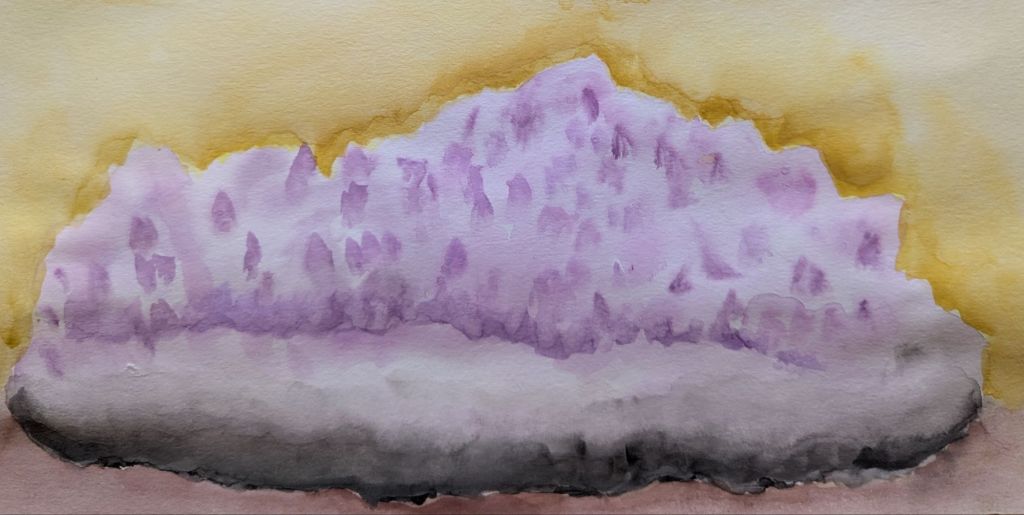
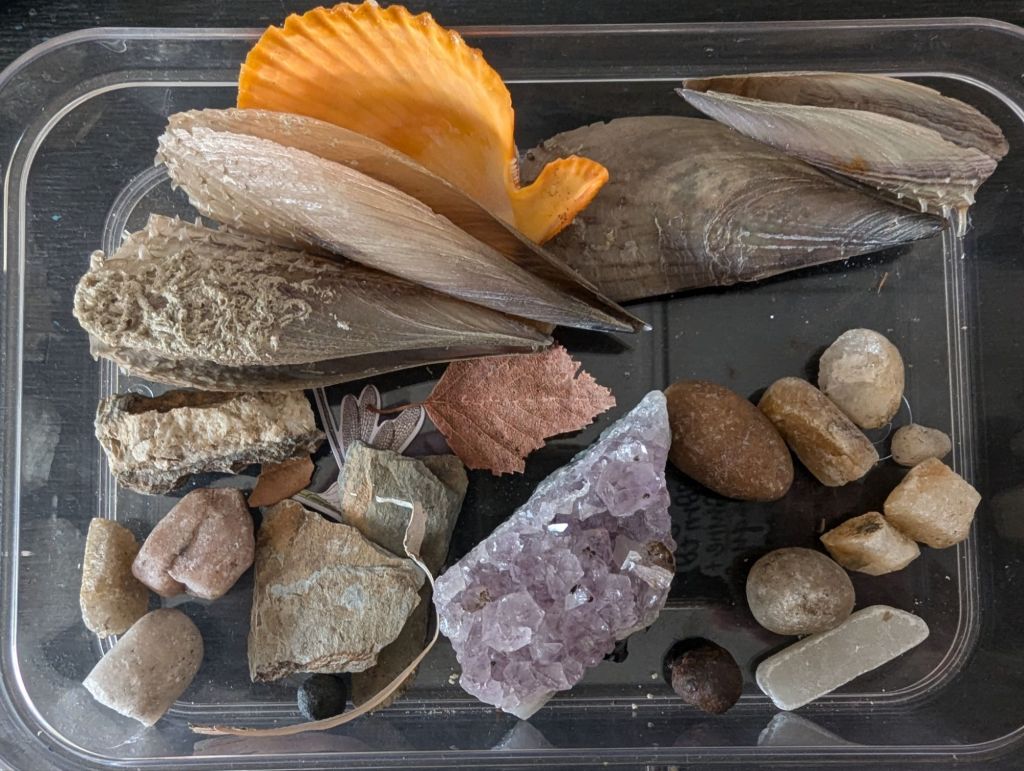
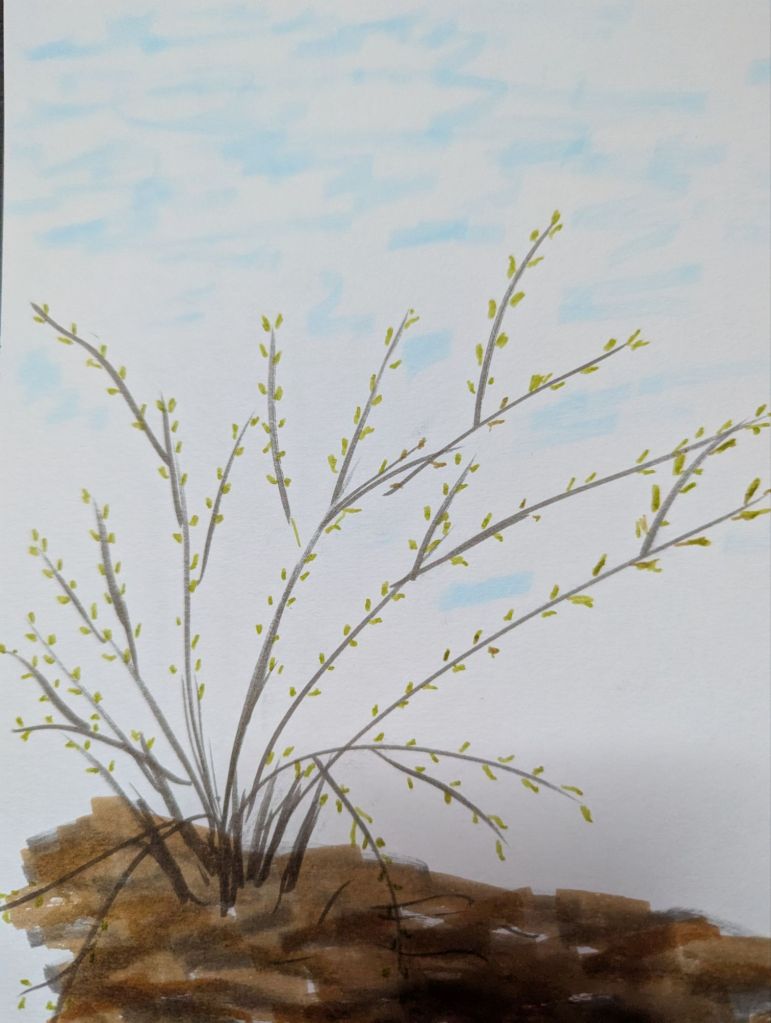
The color palette is right, but the painting, I am not so sure about. I’ve had this idea rolling around in my mind for a while. Today, I began to work on it, partly as an exercise to loosen up my mind to write, but also to show up for myself in My Create Space, a place I’ve designated for all creative projects. It is so easy to drift away into the flow of life and not give attention to the part of me that God created to be creative. Since my retirement from secular work, it was always my intention to give myself more to this creative side. I’ve done okay with it, but I still feel like it’s not the best I could do.

I determined some years ago, that I would not put myself under the pressure of being a professional artist of any sort. I’ve given it half a stab at it here and there, but over time, I came to realize that painting, drawing and making things is a gift I’ve been given to express myself and to honor God for the gifting. I do apply my creative abilities in so many other places of my life which has helped me in ministry and in my professional life, but the painting and drawing is a special communication between God and me.

Here is a reality many creatives face; we are our own worse critics and enemies to the process. If it doesn’t seem to be exactly the way we envisioned it or just like the thing we were trying to convey, we are quick to quit, speak negatively to ourselves, compare ourselves to others, and not continue to pursue the gifting, which quickly leads to creative block. I am just as guilty as many others. In the past few years, I’ve been reading up on ways to handle creative block, and the one theme that keeps recurring is, “just show up.” One of the most influential books I’ve read, reminded me that it’s not my job to be perfect, it’s my job to be present in the process and to let God handle the rest.

Today, as I was working the paint across the canvas, it slipped off the easel and hit the floor face down. I quickly picked it up and while the floor was just fine, the painting was covered with small specks of dirt and hair from the garage floor. It was a moment to decide to quit or to work through it. I decided to quickly brush off the majority of the specks and hair, smooth over the paint and let it dry.

This is the other thing about painting. It’s a hard lesson to learn, but it’s crucial to take moments to step back, to let paint dry and yes even let the mistakes become part of the overall product. Teaching myself to not be perfect has been a hard one. As I stepped back, looked at the color palette then looked at the canvas, I was reminded why I show up here in the first place, to give thanks to God for the way He has gifted me.

No matter what God has gifted you to do or be, I wanted to share this little story to encourage you, to just show up! Show up like you are presenting to the King. Don’t beat yourself down with perfection for this only One perfect being and it’s not you or me. Show up like it’s the last chance you’ve got. Don’t worry about the mistakes, they probably aren’t mistakes in God’s eyes but they are the things that He does to perfect our work. I am telling myself and I am telling you, “Just Show Up, Girl (or Man)”. You will never regret it.

Rest

In the stillness of the morning, before the world stirred, a layer of snow lay across a land that rarely sees snow. It beckoned us to rest. Unlike other places where there are stockpiles of salt and snow plows, we have to wait patiently for it to melt. It seemed that all creation and God was saying take a few days to rest, to take in the moment. It let me know just how much difficulty I/we have with being still. Our first inclination is to get busy, to make paths to our vehicles that can’t go anywhere and if we moved them, we would find that many of the places we would go, were closed. So being forced to pause, I took it all in…the reverent hush of nature, the pure scent in the air, the bright glare from the ground that lit the house like a spotlight…I took my queue from the Lord and settled in for a few days…

Rear View Mirror

“be careful that you do not forget the Lord who brought you out of the land of Egypt, out of the house of slavery..” Deut. 6:12 (NASB)

“Do not call to mind the former things, Or consider things of the past. Behold, I am going to do something new,” Is. 43:18-19a (NASB)

“Brothers and sisters, I do not regard myself as having taken hold of it yet; but one thing I do: forgetting what lies behind and reaching forward to what lies ahead, I press on toward the goal for the prize of the upward call of God in Christ Jesus.” Phil. 3:13-14 (NASB)

Photo by Mark Neal on Pexels.com

January brings on the sense of renewal. It is the time of year that we are looking at our lives, figuring out how to improve them, to start new habits and perhaps drops some old ones. It is also a time when we re-set our focus on life goals and build a determination to re-set our lives in general. We may be trying to re-boot from bad experiences, trials and tribulations, health issues, financial troubles, any variety of things. The Isaiah and the Philippians scriptures above are often repeated during this New Year frenzy as words of inspiration and hope for what the future may hold for us. I have used them for myself more than once.

But one morning, I was making the bed and I remembered that the new year began with a concern for the residents of Los Angeles, my granddaughter included, who were and are still in fear of their safety because of the massive wild fires out there. Almost instantly, the thought came to me how easily we put things into the rear view mirror of our memory banks and move on to the next big thing. It seemed that the news cycle was on top of this story and then all the sudden, it was taken over by politics, shootings etc. Now it falls somewhere down on number 3 – 5 in the list of headlines to be covered. It made me pause and wonder what and when do we need to put in the rear view mirrors of our lives. I was reminded of both the Deuteronomy text and the Isaiah and Philippian texts almost simultaneously.

The purpose of a rear view mirror is to help a driver be aware of any dangers that may be coming our way from behind us because while we are driving it is unsafe for us to completely turn around and look at what is happening in the road. It also helps us to determine if a lane shift is advisable or not. In other words, the rear view mirror is a practical aid to our driving and should never be completely ignored. It also helps us to see what we have already passed and over time, the miles begin to melt away as we move forward on our journey. On a long trip, the rear view mirror is the friendly reminder that it’s not as long as it has been. However, if all our attention is on the rear view mirror we will be completely unaware of the changes and dangers in the road ahead of us. I can remember in my driver’s education classes and even when my Dad took me out for driving lessons, that I was always told to keep shifting my vision from the rear view and side view mirrors to the road ahead and be alert for things popping up in my peripheral vision as well, so that I could be fully aware and engaged in my driving.

Some might look at the texts above and say that God is contradicting Himself. I think God is telling us how to drive through this life. Certain things we must always be aware of and remember; His Word, His promises, His commands like the way I was told to shift my vision constantly to take in the whole scope of my driving route. Other things are not meant to be dwelled upon. The sins forgiven comes to the forefront of my mind. How often do we keep dwelling on what we did in our former days that God has since forgiven? It is not a longing to return, but it is the bemoaning and blame gaming we do that prevents us from moving forward in the victory God has given us. This was Isaiah and Paul’s statement to their audiences. In effect, they are saying we can’t change the past but we trust that God has resolved it in our confession and faith in salvation so that we no longer entangle ourselves or prevent ourselves from living in the fullness and blessings God has given us in restoring our souls. Yet there is the delicate balance of remembering the lessons learned and so we should keep checking our proverbial rear view mirrors to make sure that we are not letting something creep up on us unaware. I believe that is what we see in the Deuteronomy text. That is the delicate balance I am speaking about; we should never forget where God brought us from but we can’t dwell in the past if we plan to reach our final destination, our eternal home.

Half Moon in the Midday Sky

“Then God said, “Let there be lights in the expanse of the sky to separate the day from the night. They will serve as signs for seasons and for days and years. They will be lights in the expanse of the sky to provide light on the earth.” And it was so.” Gen. 1:14-15 (ESV)

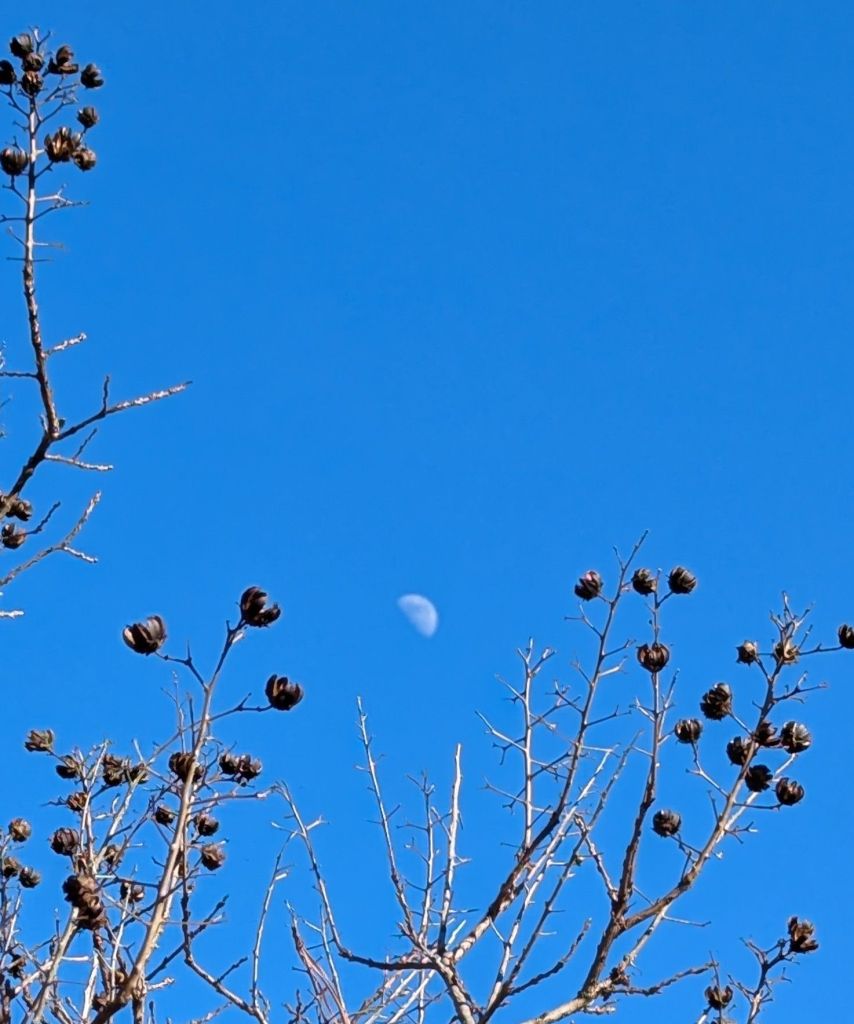
I had just started a new devotional study on the book of Genesis on Monday. The next day, while I was out completing errands and going about my day, I looked up and the moon was showing itself in the midday sky between the winter branches of a tree. I had just read the passage above the day before, and made notes of how God set the world in order down to the moon, sun and stars for the express purpose of giving us nights and days and seasons. The passage was brought back to my memory in the moment. I also remembered a seminary instructor once explaining that sometimes scriptures are not just either/or but sometimes they are both/and. The paradox of seeing the moon in the brilliance of the sunlit day was a moment of realizing the truth of the both/and.

It is true that the sun gives us our days and the moon is related to our nights. But also take notice of the text above that says the purpose of the sun and moon is also “for seasons and days and years”. In order for that to happen and if we can remember our basic astronomy classes, it takes twenty-eight days for the moon to completely rotate around the earth. In those twenty-eight days, sometimes we don’t even see the moon (new moon) and at other times we only see parts of the moon even if it happens in the middle of the day. God didn’t say that the moon would only shine at night, but that the sun would be brighter than the moon and rule over the day, while the moon would rule over the night and it was good (v. 16-19). For the greater picture of seasons, days and years to play out, God has a timing to each of these elements that relies on the rotation and the tilt of the earth around the sun and the moon around the earth that sometimes causes the moon to be in the sky at the same time that the sun is shining but it is never brighter than the sun. What struck me in the moment was both the sun and the moon were shining, and, due to the tilt of the earth, in this hemisphere we are in the depths of winter where everything is stripped bare and the air is notably cooler.

The sight of this helped me to realize that while there are some things that are clearly either one way or another, God also allows us to experience things in tandem, often at the same time. On this particular day, I was recovering from a meeting that went off the deep end the night before, sorting through what had happened and how to resolve some of the issues. I had taken a drive through the country to another town to visit someone in the hospital. The route my Google maps took me on was different than ones I had taken in the past. It was like the AI that runs the applications knew I needed to decompress and regain my peace and composure. So when I stepped out of the car and crossed the hospital parking lot, I saw the scene above and I was reminded that days can be both chaotic and peaceful, happy and sad, rough and easy and the same God who placed the sun and the moon is over all of it.

More importantly the reality of this both/and paradigm shows me that no matter what the situation, no matter how out of place it might seem, there is always a bigger picture, where God is guiding my days, nights, seasons and years to fulfill His purpose. Sometimes, we demand the simplicity of clear boundaries of either this or that when in fact, it seems to me the majority of our lives are a blurred line of both/and. When I can take a moment to step back from my expectations and behold the beauty of life with all it’s intricate ins and outs, then I can appreciate how sometimes the half moon shines in the midday sunlight and it is good.

Like A Sore Thumb

Command and teach these things. Let no one despise your youth, but set the believers an example in speech and conduct, in love, in faith, in purity.” 1Tim. 4:11-12

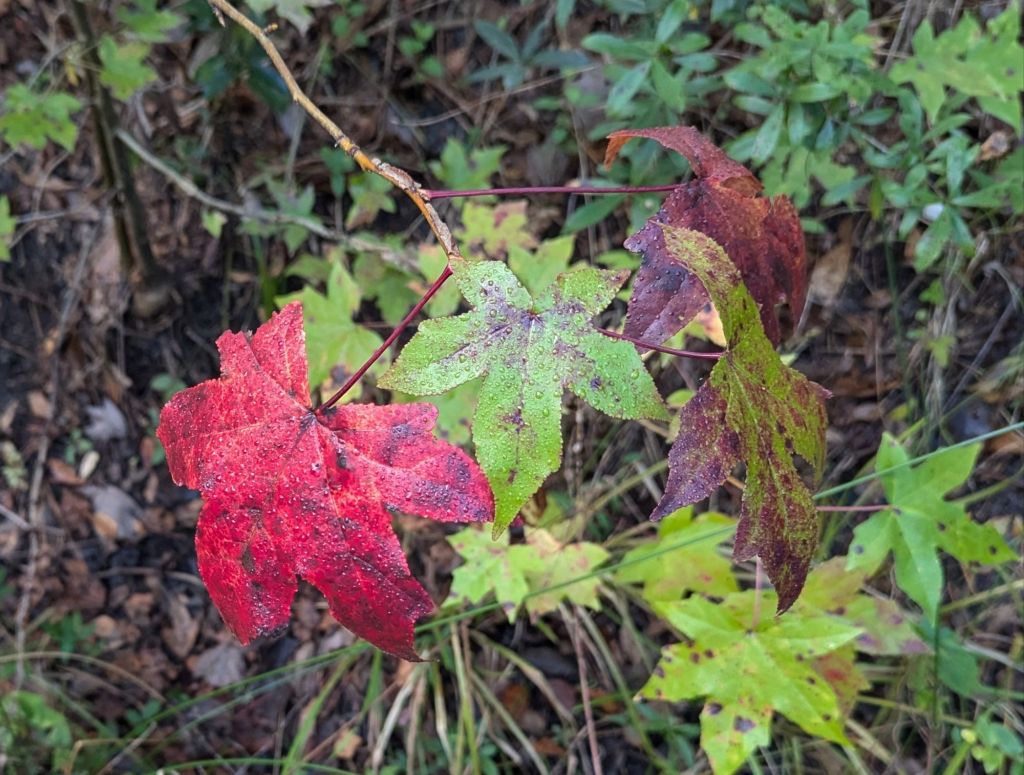
As I walked along the road one morning, my eye was drawn to a singular red leaf on a branch of green and partially changed leaves. It is autumn, so a red leaf in and of itself is not unusual, but when I saw that it was the only red leaf on the branch, it really stood out. My mind immediately thought about those who are gifted leaders. My first thought was Timothy, who was a young man that demonstrated strong leadership skills (Acts 16:1-3) but it also appears that his leadership put him on the outside fringes requiring Paul to remind him more than once to exercise his gifts. The text above is one such exhortation.

My second thought was about Peter who repeatedly took the lead in questions and comments to Jesus. He was a brash personality that Jesus would have to rein in from time to time as he spoke out of turn or acted rashly. It was Peter who responded first to Jesus’ call but also would question Him about forgiveness (Matt. 18:21), who wanted to direct Jesus in His ministry by stating that the crucifixion would never happen and had to be rebuked (Matt. 16:22-23), he declared he would never deny Jesus (Luke 22:31-34) and he also was the first to declare Jesus as the Messiah (Luke 9:20). Peter was also the person bold enough to walk on water (Matt. 14:28) and lopped the ear off of a someone in the crowd that arrested Jesus (John 18:10-11). Peter was the ringleader of the disciples (Mark1:36; Luke 22:32). Despite his rashness, Jesus recognized the leader that he would become by declaring that the church would be built upon him and his confession of faith (Matt. 16:18). Indeed, he became that leader on the day of Pentecost (Acts 2:14).

These are two strikingly different personalities and yet both are considered as leaders in the early church. One demonstrated leadership in his consistent godly character and the other in his boldness of character. In their own way they rose to the forefront of the church and I imagine in their own way they must have felt like they stuck out like a sore thumb amongst their peers.

The gift of leadership is a bit of a dichotomy. By definition, a leader is in front of a group, a forerunner, often more advanced in thinking than their peers. The flip side is that the leader can feel isolated and alone for the very reasons that they are identified as a leader. Spiritually speaking a leader’s gifts will make room for them (Prov. 18:16) which means that they often find themselves in charge of a ministry project, a small group or a board. It usually happens simply because, the leader begins to express ideas or formulate an action plan almost effortlessly that pushes them to the front of the room, the head of the class or first in line. No matter how much they may try to keep quiet, invariably they can’t help but express an opinion, a strategy or a new viewpoint that makes heads turn. It can make the person feel like they stick out like a sore thumb.

I am familiar with this dichotomy, and I lean more towards a Timothy type of leader, often questioning the role I am in or the direction God is taking me. I have sat in meetings countless times, vowing to never say a word and it only takes one comment that doesn’t make sense to me, and I am on my feet and my mouth is speaking. To that degree, I may be more like a Peter. Either way it goes it often feels like I am the only one out there and a bit of sore thumb in the crowd. People trust my leadership skills even when I don’t trust them. But the thought processes that get me to my feet or open my mouth, seemingly sets me apart from my peers like a sore thumb.

So what does this beautiful red leaf teach me today? Leadership gifting does set me apart from the crowd and God makes it obvious to all around me. I can downplay the gifting by stating that I stick out like a sore thumb or I can display it like this red leaf as a glorious and beautiful gift I have by God’s grace.

Ekklesia

“And let us consider how to stir up one another to love and good works, not neglecting to meet together, as is the habit of some, but encouraging one another, and all the more as you see the Day drawing hear.” Hebrews 11:24-25 ESV

I was sitting on the porch one evening and noticed this mound in my backyard. I had to go down and take a closer look to discover that it was actually a mound of mushrooms with other smaller mounds growing around it. I had to do a quick Google search and discovered that this mound of mushrooms is called hen-of-the-woods. I’ve seen them before, but this particular mound was much larger and taller than I had seen before. Up close, it is clear that it is not one mushroom but multiple mushrooms growing closely together. Interestingly, they come from one root stalk but they multiply by spores on the underside of each spoon-like top. They are edible and they are useful to the ecological systems of the forest, helping to decay rotted tree stumps and return nutrients back into the soil. They remind me of what the church should be like. How so?

The word for church in the original Greek language is ekklesia. It means an assembly of the called out. Jesus was the first to use the phrase when Peter confessed who Jesus was (Matt.16:18). There Jesus says that upon Peter and his confession, the church would be built and that the gates of hell would not prevail against it. In Acts 11:26, Antioch is the place where the ekklesia is named Christians and it is this same ekklesia that would ordain and send Paul out on his first missionary journey (Acts 13:1-2). Other examples of the ekklesia in Acts show us that the church prayed and gathered in various places, helping one another to grow in their faith. The ekklesia of the New Testament was not a particular denomination, simply a gathering of believers. People have made it so much more complicated than it has to be. So how does this mound of mushrooms remind me of the church?

First, it is made of many parts but it is all on one stalk. The church is made of many members but our one stalk is Jesus Christ. Second, the cluster of mushrooms is working together to grow more mushrooms. We should also be gathering together in our various gifts and abilities to grow strong Christians. Third, this cluster of mushrooms is contributing to the health of its ecology and making more colonies in its vicinity. (If you look closely, you will see a smaller mound in the background). The church should be making an impact on our world and society and expanding its work in other parts of the world around us.

This clump of mushrooms has given me some things to consider about myself and where I fit in the ekklesia we call church. Am I connected to the stalk? I believe so. Am I working in cohesion with my fellow believers to help them grow in love and good works? I strive to make it so. Does the work I do replenish and spawn new disciples? I would like to think so. Does the ekklesia I am a part of look as tightly connected as this hen-of-the-woods growing in my back yard? I certainly hope so. In any case, I have this very real reminder of what ekklesia is all about.

Abiding

“I am the vine; you are the branches. Whoever abides in me and I in him, he it is that bears much fruit, for apart from me you can do nothing.” John 15:5 ESV

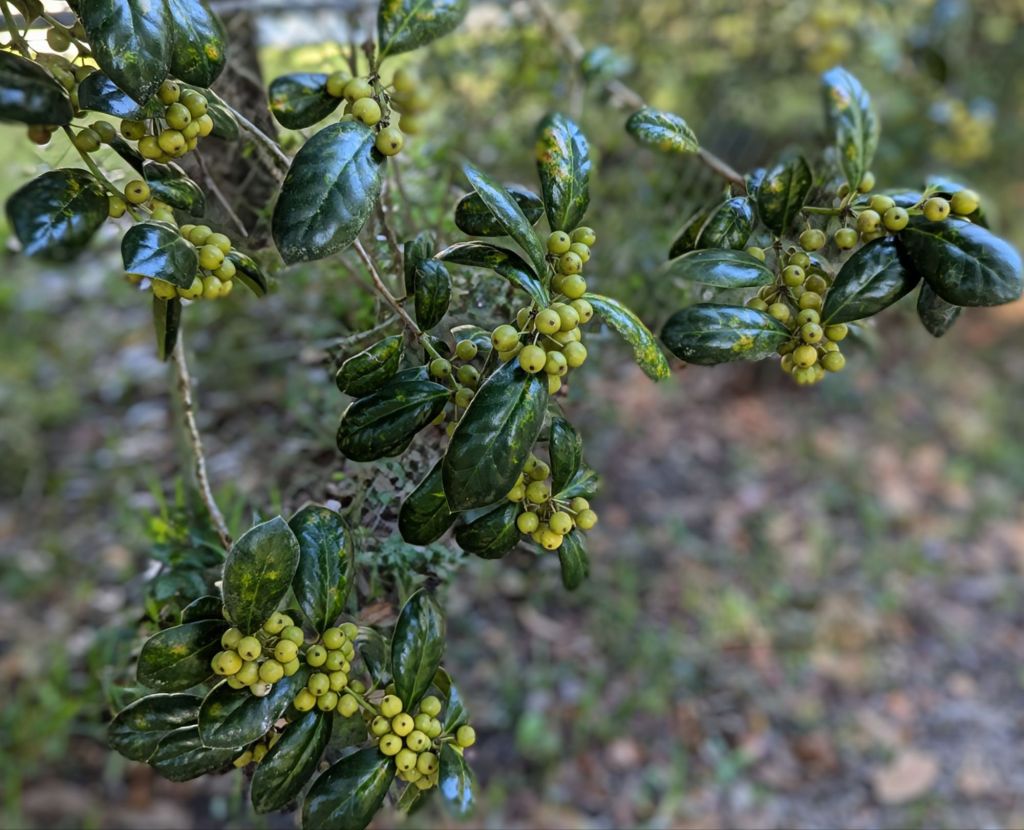
Fall is slowly coming in SC. I was out walking one morning and saw this holly bush heavy burdened with berries. In a couple of months they will be the familiar red berries everyone sees at Christmas time. It reminded me of myself to some degree.

Lately, I’ve been feeling like God is moving me from one season of my life to another, especially in the realm of ministry. The Spirit has had me observing the subtle changes of fall and applying what I observe to how God is working in my life. I am in the place of in-between and waiting as patiently as I know how to step into my next phase, whatever and wherever that leads me.

By almost every spiritual gift analysis I have ever taken, I am a heavily gifted person. I understand that fully and I also know that I have not been fully active in some of those gifts. Perhaps this partly to a lag in faith on my part, but more importantly, I see it as a situation where God has been developing other gifts to build me up to the place where I am fully active in all the gifts (if that makes sense). It is an error I see some take — to see what their gifting is, then declare them and try to engage in all of them without letting God grow us and ripen us for the right season. I have been watching myself ripen in the gifts that I have been engaged in, but there are more that God needs to finish ripening in order for me to be the most effective servant possible.

These green holly berries are truly plentiful but they are not ripe yet. They need to remain on the bush a little longer, receive nutrients from the bush, be bathed in the autumn sunlight and yes, endure a cold snap or two with heavy frost before they will come to be the plump red berries that we like to see decorate our homes with at Christmas. Without going through the natural process of ripening, they will rot or fall off the bush before time. They are in the in-between stages of existing but not yet in season. Jesus gives us a beautiful example of how we are to grow in Christ and in our faith walk. First, we must be attached (salvation), then we have to grow (spiritual formation activities) and then we will bear fruit (discipleship). None of this happens if we don’t take part in a seemingly idle activity – abiding. Abiding simply means to remain. We remain in Christ when we participate in fellowship, pray, worship, meditate and study God’s word. We remain in Christ when we trust Him in the hardest of times and delight in Him in the best of times. It seems like a simple enough task, but the throws of life can make it very difficult. Our own doubts, fears and faltering faith make it very difficult. But the promise here is that if we remain in Christ, we will bring forth an abundance of fruit that will cause others to turn to Christ. The caveat is in the last part of the verse. When we don’t abide in Him, nothing of any spiritual good will come from us. We will be like berries that rot on the branch or fall to the ground. It seems like such a waste of energy to let that happen. And when I consider my personal spiritual growth, the place where I am now of in-between, I will continue to wait patiently for the changes that are coming because I want to be fully ripened to do all that He has for me to do.

Treasures

“Now we have this treasure in clay jars, so that this extraordinary power may be from God and not from us.” 2 Cor. 4:7

Ever since I was a child I collected “treasures”. My treasures were never gold, silver or jewels but natural objects that caught my attention as I wandered through woods, streams and anywhere I went. I have always been fascinated with rocks and shells. But I will collect feathers and leaves and sticks as well. To the ordinary eye they may look rather ordinary, but in my eyes they are wonderful moments of awe at God’s creation. The collecting has not really stopped, just scaled back in adult life. Now I keep a tray on my art table of these treasures. They are reminders of moments in time, paths I have walked or the sheer wonder of God’s creation. My daughter came by one day and noticed my little treasure box and she was thrilled to see it and to know that she was not alone in her treasure hunting either.

When I pick up these various items and examine them, they often have rough exteriors and imperfections but there is a unique quality in each of them that caused me to take notice of them in the first place. Jesus would use finding treasures as a parabolic teaching to understand how precious God’s word is to us (Matt. 13:45-46;Luke 15:8-10). But He would also warn us to not store up treasures on earth and miss the treasure of heaven (Matt. 6:19-21) and to be mindful that out of the treasures of our heart our mouths will speak (Matt. 12:33-37). But one of my favorite texts about treasures comes from 2 Corinthians where Paul is explaining who he is in ministry and really who all of us are in God’s sight if we are choosing to live for Him.

The treasure is Christ living on the inside through the Holy Spirit. God saw fit to hide this treasure in meek and simple vessels like our weak and worn bodies. The purpose is not to hide it from the world for fear of it being stolen. No, the purpose is to cause those who will search beneath the surface of our circumstances, weaknesses, confusion and despair to see the real sustaining power of Christ at work in us and through us. This power will cause us to smile at those who persecute, press forward when pushed backwards, and get up when we receive life threatening blows. Most jewels are hidden in dingy rocks, gold has to be mined and silver has to be refined. So those who have Jesus living on the inside are precious jewels and metals in God’s sight, we just happened to be dressed in earthly bodies that are prone to wear and tear, imperfect shapes and sizes. We are the vessels of God’s heavenly treasure waiting to be unearthed to show forth His love and power to any and all who will look and see.

Building the Church

“He himself granted that some are apostles, prophets, evangelists, pastors and teacher to equip the saints for the work of ministry, for building up the body of Christ…” Eph. 4:11-12 (NRSVue)

I like building things. I recently bought some studio furniture that came neatly packaged in flat boxes barely two inches thick. My husband offered to build them for me and when I declined his help, he offered his power tools, I declined them also. I explained that these are relatively easy pieces to put together and having built some other pieces from the same manufacturer that were more complex than these particular pieces, I was confident that I had the skills and ability to complete the job to my satisfaction. It isn’t that I don’t appreciate his help or his tools, I like the satisfaction of building these things and then outfitting them the way I want them to be. As ministers and leaders of the church, it is equally important that we enjoy the work of building the church to God’s satisfaction but also for the joy of watching others grow into their unique gifts and abilities that will expand the church and it’s impact on the world.

The text above is one that I return to frequently because it reminds me of the calling God placed on my life. In it, I understand the ministry gifting God gave me, but the more important part is not the title or the office, but the reason for the gifting, to equip and build up the church. Some will read this text and be more focused on which ministry office they want to be identified with and completely loose sight of the purpose of the various ministries. It is nice to be called a title. It is good to know exactly what God called us to be. But we must not stop there. Paul reminds us in Romans 12 and 1 Corinthians 12 that spiritual gifts are never meant to be stand alone operations but they must work in concert with the others. A truly thriving church will do that, but only if the understanding in Eph. 4:12 is applied to the working of the gifts. When I read this text, I get centered on the unique calling God gave me and it provides a means to gauge how effective I may or may not be in carrying out the calling.

It is that time of year for me, when I will make a report of the ministry for the past year. Statistics will be given, improvements to the church building and an outline of church programs will be highlighted. We will acknowledge new converts and new members but also the exit of some and the passing of other members. Statistics alone cannot measure the work of the church. The true measure of the health of the church is how and if the members have grown spiritually, matured in faith and begun to walk in their gifts. As the pastor, I am constantly keeping my eyes on the church as a whole and on the individuals as well. When I see someone try new activities, hear someone give their testimonies of how God has blessed them, or watch someone engaging in their spiritual giftings for the work of the Gospel, I am satisfied, that the job is being done, the saints are being equipped and the church is being built up. It gives me as much pleasure as building my own studio furnishings. However, there are times when it seems that there is no growth, no maturing or building happening. If it’s a construction piece I am working on, I have to review the instructions and make sure that I did all the steps correctly and make the necessary adjustments. If it’s the church, I have to review the instructions (the Bible) and make sure that I am doing what I am commanded and called to do to make the necessary adjustments. The problem solving is just as much a part of the building as the actual construction work. That is also something I like to do.

It seems God knew just who I was and what I like to do when He called me into this ministry and gave me the gifts I needed to accomplish His will. I like building things.

Resurrection Power

“That I may know him, and the power of his resurrection, and the fellowship of his sufferings, being made conformable unto his death” Phil. 3:10 KJV

Here in the South people come from all over to marvel at the live oak trees draped in Spanish moss. Many are surprised to find that the trees are often covered in a type of fern commonly called resurrection fern. Like the Spanish moss, it is not a parasitic plant but one that gets its nutrients from the air, rain, water and the debris accumulated around the plant. It can live on other types of trees and stumps but it seems to like the live oak best. It relies on the oak for support, not for survival. It is so named because the fern is highly resistant to dry spells and droughts (which can be frequent here in the summer months) and during these dry seasons it will shrivel and turn brown to conserve itself. With any passing shower or period of rain, the moss will quickly turn bright green and lush all over again, giving it the appearance of being resurrected from the dead. This relationship between the fern and the oak is beneficial to the environment also, as it provides a habitat for a variety of insects, birds and animals.

Recently we had a few days of rain (tropical storm and the threat of flooding) that caused me to look at these plants once again. A limb covered in ferns fell from one of our stately oaks at the driveway entry. There was no damage to property and as I examined it, I was thinking like so many that the limb became weak from the weight of the ferns and the rain. My thoughts in looking at it and in terms of what could I say about it was leaning more towards the dangers of toxic relationships, until I did my research. Then, I saw it in a completely different way. The limb was old, rotted and heavily pecked by birds and insects. That was what made the limb eventually fall. Upon examining it, and with research in hand, I realized that the ferns were probably what helped the limb to hang on for as long as it did. That got me thinking about our relationship with Christ.

Paul was a man who endured greatly for the Gospel. Beaten, whipped, stoned, left for dead, imprisoned and eventually shipwrecked, he lets us have an inside look of what it meant to be Paul even in the dark and dry places where he was routinely rejected for the faith. Paul hinged everything on his understanding of what Jesus endured on the cross and the power of His resurrection. His one sole desire was to know Christ so personally and intimately that they would be barely indiscernibly distinct beings.

If we were to relate it to the oak tree and the fern, to look at it one would wonder if the tree is forming the fern or the fern is forming the oak. I think it goes either way. In Paul’s dry places, he would be like the fern, looking dried and shriveled but supported by the oak, refreshed by the resurrection power of Christ. But also when the load seemed to be too much and he would be perfectly happy to die and be with Jesus, he would be the old limb on a tree and the fern would be the thing that gave him the wherewithal to continue on his mission. The relationship he had with the resurrected Christ was intertwined with his spirit, much like the relationship between the oak and the fern. Eventually his body would give out, but the resurrection power would lift him to his eternal home.

Paul wanted everyone to have this same kind of relationship with Christ and to know that when we are connected to the resurrected Christ, that power would be in us to endure the storms, the droughts, the dry places that will cause us to wilt, curl and look dead. That power can resurrect us here in our daily lives and ultimately in our eternal life.