
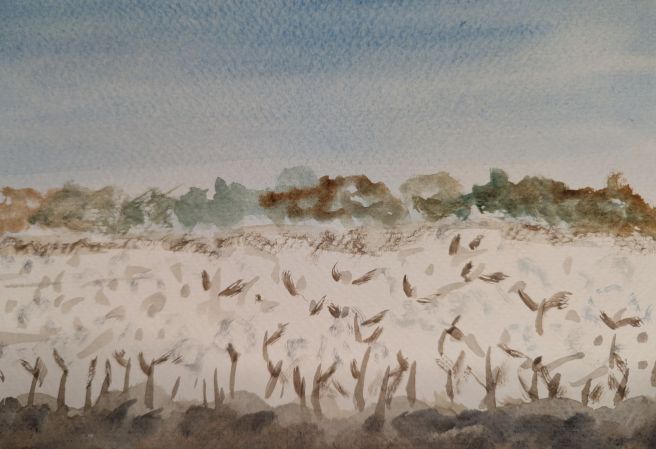
“…Lift up your eyes, and look on the fields; for they are already white to harvest.” John 4:35b (KJV)
“He said to them, ‘the harvest is plentiful, but the laborers are few; therefore ask the Lord of the harvest to send out laborers into his harvest.” Luke 10:2 (NRSVue)
It’s cotton picking season in the SC farm regions. Being from Pennsylvania, the first time I saw cotton fields ripening to be harvested, was a sight to behold. There is nothing quite like the contrast of the cotton bolls still on the brown stalks against the backdrop of a Carolina blue sky. I am still enthralled by the sight. However, I also have some mixed feelings because I know that this crop in particular was labor intensive in times past. Now there are all types of machines to pick and bale the cotton for market. I am cognizant of the fact that not that long ago, the process was much different. My husband, as a young child was taken to the fields to pick cotton along with his siblings and led by his mother. I have heard many a story about how hard it was, how they would hope the dew was still on the cotton when they picked it so as to get more weight in their bags and how one sibling was able to pick more cotton in a day than any of them. Mixed with the stories of the labor involved, are fond memories of family together and Mama making a meal in the field with a fire, a pot of rice and cans of pork and beans. The even harder truth is that, cotton has significant ties to slave labor in the South and its abuses. So while I can see the beauty of the field itself, I must remember that for some, it may not be so beautiful. After the mid 1950’s and 60’s the feasibility of manual labor for cotton was depleting and farmers had to invest in the machinery we see today. Still when I see the cotton fields of October and November as I drive down country roads I am reminded of the Bible texts above.
In the first one from John, the Samaritan woman just had an encounter with Jesus at the well in the middle of the day. She went back to town to tell about how she met “a man who told me everything I have ever done.”(John 4:29). The townspeople came out to meet Jesus to see whether or not she had met the Messiah. At that point, when Jesus saw the crowds, he told the Disciples that the fields were ripe for harvesting. In other words, He was letting them know that many are eager for a savior. It was their job to bring them in even though they did not plant the crop. In the second text, Jesus was sending out seventy-two followers to spread the Gospel. He sent them with a similar message. There is a harvest of people ready to receive Jesus, more than they could handle all by themselves. They were told to pray that God would send them helpers to gather in the lost. I find the same to be true even today. In a broken world, people are still looking for existential answers for their lives. People are trying to make sense of the madness, looking for purpose and find hope for their future.
I can easily put myself in the scene as Jesus spoke to the Disciples about the fields being ripe for harvest as the Samaritans came to see Jesus and feel how overwhelming it must have been to hear Jesus tell them to reap a harvest. I can equally imagine the same sense of being overwhelmed when Jesus said that the laborers are few but the harvest was plentiful. As a pastor, teacher, minister of the Gospel, it is easy to fall into the trap that it’s my duty alone to reap the harvest. FALSE! Or that it’s my duty alone to inspire a congregation to go reap the harvest. FALSE! That is a quick path to burnout. While I can see that there is a harvest to gather in, the texts remind me that as one of the called, I have to rely on God to provide the help that is needed. That means a life of prayer, of witnessing, of serving others, of living as much of a Christ-like life I possibly can, which is the labor that gets us to the point of harvest just like the farmers have work to do that gets to their harvest season. The difference between farmers and Christians is that harvest season is not limited to one time a year but it is on-going. That in itself can seem a bit overwhelming. The key is to remember that we cannot do it all alone or by ourselves. We have God to help us, to lead us and show us where to go and what to do. Furthermore, we are told to ask God to send help. As a pastor, teacher, minister of the Gospel, it reminds me to ask God for the help I need.
The process of getting to the cotton fields full of white bolls is long and tedious. There is the tilling, the planting, the fertilizing and spreading pesticides, the watering, the waiting and hoping that the weather will be just right, and then the blooms and then the ripened pods. The process of spiritual harvesting takes time also. We cannot plant seeds of faith today and expect a crop tomorrow. Indeed, we may plant and not see the harvest for ourselves but we place our trust in God to allow our seeds to grow into a harvest at some point (1 Cor. 3:6-7). These cotton fields are a friendly reminder to me from God to keep tending the fields He has given to me to till, plant, water and reap.
 Random Thoughts of an Ordinary Woman